
Should I Swaddle My Newborn Baby?
This is one of the most common questions parents ask me, and it’s a little funny given that I’m a postpartum doula at MothersCare myself. You’d think that would mean I had it all figured out with my own kids. I did not. Sleep deprivation doesn’t care what you do for a living, and there were nights I genuinely forgot the same things I tell my clients every week.
Every baby is born with the Moro reflex, also known as the “startle” reflex, sudden jerky movements that wake them right back up the second they finally drift off. Learning how to swaddle a baby correctly can help calm that reflex, and for a lot of families, it’s the difference between 20-minute naps and actual, real sleep.
Nobody tells you how loud a swaddled baby can protest before they settle, though. At 3am, when your baby is squirming and red-faced and furious about having their arms contained, it’s easy to convince yourself they hate it and you’re doing it wrong. Here’s the truth: a lot of babies fight it hard for those first few seconds and then settle right down once they’re snug. There’s no one-size-fits-all answer, every baby is different, and how you swaddle is a personal call, not a test you can fail.
We actually hired a postpartum doula in Fairfield for a full week after my first was born, someone local who could come right to us. Best money we spent, hands down. She handled the stuff nobody warns you about, the laundry, the “here, eat something, I’ll hold him” moments, the reminder to shower on day four. But when that week ended and I was on my own, that’s when it got hard, especially overnight.
With my first, I’d registered for a stack of those beautiful muslin swaddle blankets, the kind you see folded all soft in nursery photos, convinced that’s all I’d need. HA. He broke out of them within days, sometimes within the hour, and I remember standing in his nursery rewrapping the same blanket for the fourth time wondering what I was doing wrong.
From there I tried what felt like every swaddle blanket on the market. Some styles worked better than others depending on the baby. My first preferred a snug, arms-down swaddle. My second did much better with an arms up swaddle, more freedom to move, less fighting to get there. Neither is more “right,” they’re just different babies.
If you’re ready to actually try it yourself, here’s how it breaks down.
How to swaddle a baby: the basics
- Lay the swaddle blanket flat in a diamond shape and fold the top corner down to make a straight edge.
- Place your baby on their back with shoulders right at that fold line.
- Pull one side of the blanket snugly across your baby’s body and tuck it underneath them.
- Fold the bottom point up and over their feet.
- Wrap the remaining side across and tuck it in, snug but not tight, you should be able to fit two or three fingers between the blanket and your baby’s chest.
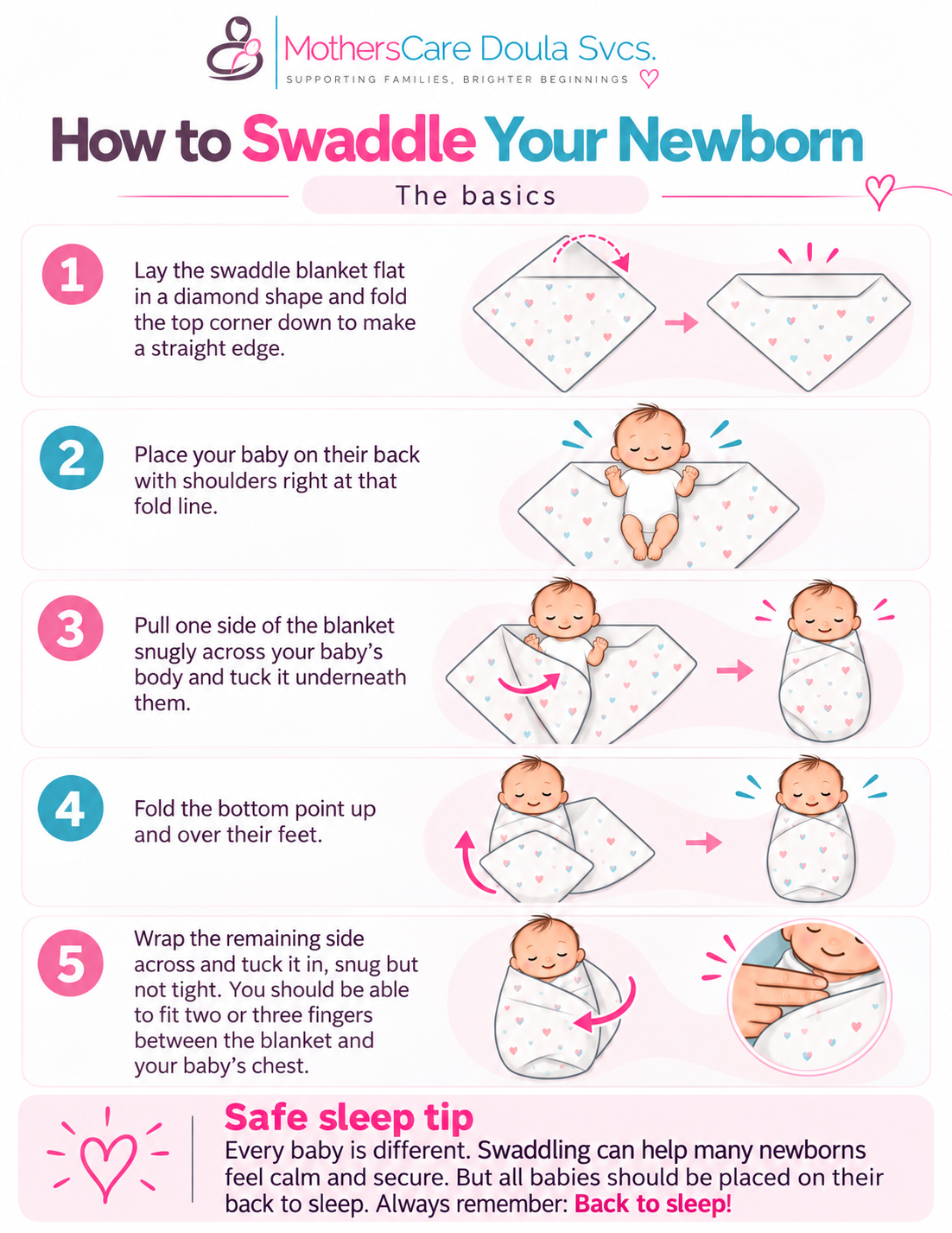
That’s how to swaddle a newborn with a basic blanket, and it works the same whether you’re using a flat muslin square or a bigger receiving blanket. If you’d rather skip the folding entirely, a swaddle sack with velcro or zip closures does the same job with a lot less 3am geometry, which is honestly where a lot of families land after week one.
Frequently Asked Swaddling Questions
How long do you swaddle a baby?
Most babies do well swaddled from birth until they start showing signs of rolling over, usually somewhere between four and six months. Once rolling starts, it’s time to stop for safety.
Why do you swaddle a baby?
It mimics the snug feeling of the womb and helps calm the startle reflex that otherwise jolts babies awake mid-sleep. For a lot of babies, that translates directly into longer stretches of sleep.
When does the startle reflex settle down?
It’s usually strongest in the first couple of months, then starts to fade gradually, often easing up noticeably by around three to four months. Once it’s fully gone, usually by six months, you likely won’t need to swaddle at all.
When should you transition out of a swaddle?
The moment your baby can roll from back to front or shows real strength pushing against the wrap. Some families go straight to arms-out sleep, others move to a wearable sleep sack first.
Can you swaddle a baby too tight?
It’s a real risk if the wrap is snug around the hips and legs, which can affect healthy hip development. The chest and arms should be snug, but the hips and legs need room to bend and move freely, the International Hip Dysplasia Institute has good guidance on what that actually looks like.
What is a swaddle?
A swaddle can mean two things: the act of wrapping a baby snugly to help them feel secure, and the blanket or fabric sack itself. So “swaddle” works as both a verb and a noun, and either way it comes back to that same snug, womb-like feeling.
Should I swaddle my newborn at night?
Plenty of families find nighttime swaddling makes the biggest difference, since it’s when the startle reflex causes the most wake-ups. Just make sure your baby is always placed on their back to sleep, swaddled or not.
Swaddles MothersCare Doulas Use and Love:
Halo: I highly recommend Halo swaddles because they were a genuine game changer, easy to use, and they kept my baby snug and secure through the night.
Swaddleme: SwaddleMe swaddles were the first ones I ever used, especially those very first tiny-newborn weeks. Easy to use one-handed at 3am, and the cute prints didn’t hurt either.
Swaddles I’d try next time around:
Kyte baby swaddler: We found Kyte baby after my kids were already out of swaddles, but we love their sleep sacks and bamboo pajamas so much I’d grab one or two of these next time.
B.E.S.T. Swaddle: I haven’t tried the Taking Cara Babies swaddle myself, but once I learned it’s designed to be quiet, no loud Velcro rip in the middle of the night, it went straight to my “next time” list.
If you’re staring down those first few sleepless weeks and wondering how you’re supposed to figure any of this out on no sleep, you don’t have to do it alone. That’s exactly what we’re here for, whether it’s a few overnight visits to help you get your bearings or a full week of hands-on support like I had. And if you’re currently pregnant and just getting a head start on your research, we can be with you for the birth too, not just the weeks that follow.
Reach out and let’s talk about what support could look like for your family. Because whether you end up with the perfect swaddle on the first try or rewrapping the same muslin blanket for the fourth time at 3am, you’re learning your baby as you go, and sometimes having someone beside you while you do it makes all the difference.